
Kicking 2026 Off With FIVE PSAT Tag Recoveries!
At the start of 2026, OCEARCH and our collaborators achieved something truly remarkable: the successful recovery of multiple pop-up satellite archival tags (PSATs) deployed on white sharks, each tag unlocking new assets into the understanding of their life below the surface.
What Is a PSAT Tag?
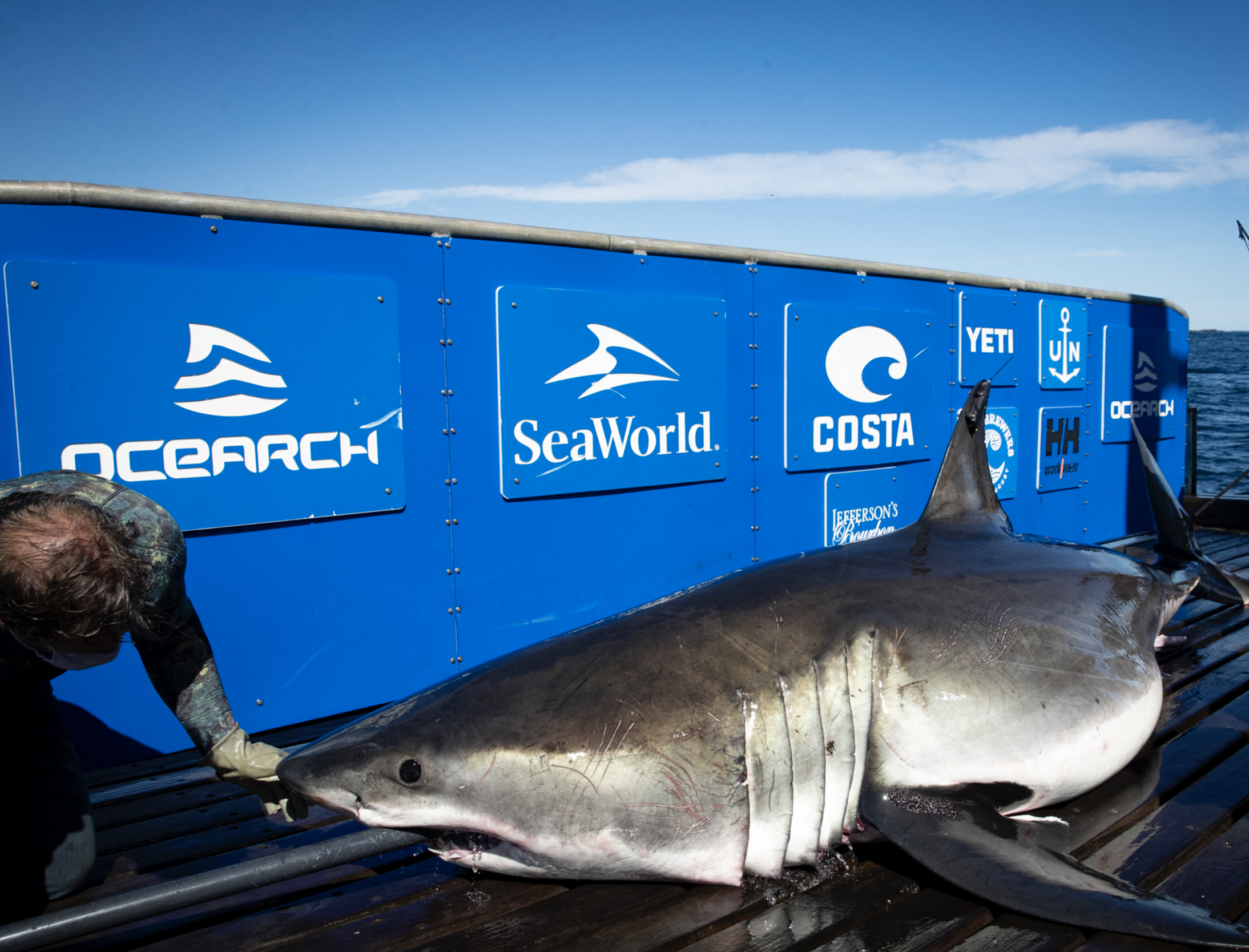
A PSAT tag is a powerful research tool designed to reveal where large migratory marine animals like sharks go when they disappear beneath the surface. The PSAT tag is attached near the base of a shark’s first dorsal fin, the tag records detailed environmental data over time, including depth, water temperature, and light levels while the shark is traveling through the water. This information allows scientists to understand how sharks move through the ocean in three dimensions…far beyond what surface tracking (a SPOT satellite tag) alone can show.
After a pre-programmed period (or in some cases earlier than expected), the PSAT tag detaches from the shark and floats to the surface of the water. Once at the surface, the tag begins transmitting a summary of its archived data as well as its location via satellite, signaling that it’s ready to be found. While it’s not necessary to recover a popped-off PSAT tag to obtain data, it’s a wonderful bonus for us to actually go out on the water and find it, download the complete data set, and then reuse a refurbished version of the tag next time!

From the Open Ocean to Scientists’ Hands
This is where teamwork makes all the difference!
Recovering a PSAT tag is often compared to finding a needle in a haystack. Once a tag pops off, it’s up to OCEARCH and its Tancook research partner along with a network of trusted collaborators, captains, and fellow mariners to locate and retrieve it in the open ocean. These recoveries depend on precise navigation, favorable sea conditions, and quick action before the tag drifts too far and is lost or depletes its battery. We also rely on a device called a goniometer – a sensitive instrument that can detect the signals coming off a PSAT from miles away. It provides signal strength and directionality and essentially guides the user to the exact location of the tag.
Once recovered, each tag is sent back to Wildlife Computers, the manufacturer of the PSATs, where the full dataset is downloaded and processed. Scientists then can analyze the information to better understand shark behavior, habitat use, and movement patterns across the western North Atlantic.
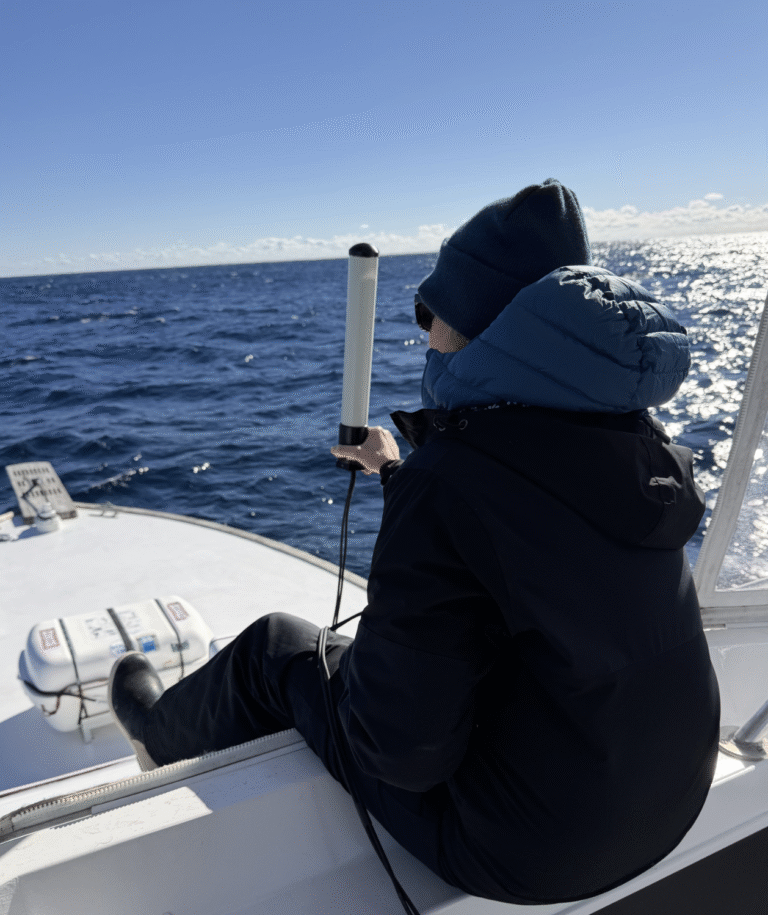
“Recovering a PSAT tag is a huge win for science,” said John Tyminski, Senior Data Scientist at OCEARCH. “When we combine this full, high-resolution PSAT dataset with the SPOT tag data you see on the OCEARCH Global Shark Tracker, we gain a much more complete picture of how white sharks move through their environment and use different habitats.”
Recent PSAT Recoveries
So far this year, five PSAT tags have successfully detached and been recovered. We are currently awaiting the full datasets from Wildlife Computers for each of these sharks:
WHITE SHARK BELLA (Apr 15)
Female, Juvenile, 10’ 2”
The PSAT tag was deployed last July off Mahone Bay, Nova Scotia, in collaboration with the Tancook Islands Marine Field Station. Recovering Bella’s PSAT Tag enables us to directly download every data point archived during the deployment. In this case, it amounts to 270 days worth of depth, temperature and light level measurements, recorded every 5 seconds. So it’s a goldmine of data. The tag detached in the northeast Gulf of Mexico, about 20 miles south of Dauphin Island. The NOAA recovery team was led by Dr. Eric Hoffmayer and assisted by Michael Hendon and Shawn Trochessett.
WHITE SHARK ERNST (Jan 28)
Female, Sub-Adult, 12’
Ernst’s PSAT detached and began transmitting in the northern Gulf of Mexico, east of New Orleans. The tag was successfully recovered east of the Chandeleur Islands by OCEARCH’s own DJ Lettieri and Captain Brown Frenette.
WHITE SHARK RIPPLE (Jan 23)
Male, Sub-Adult, 11’ 6”
Ripple’s PSAT detached early in the northeastern Gulf of Mexico. The tag was recovered by the OCEARCH team with the help of Kim Bassos-Hull with Mote Marine Lab & Aquarium, and Captain Warren Smith approximately 30 miles off St. George Island, Florida.
WHITE SHARK BAKER (Jan 22)
Male, Adult, 12’ 10”
Baker’s tag also detached on schedule after 180 days since his initial tagging and sampling, and was recovered by the North Carolina Shark Conservancy, Reelebugging, and Captain Bobby Earl northeast of Cape Hatteras, North Carolina
WHITE SHARK JASON (Jan 19)
Male, Sub-Adult, 9’ 4”
Jason’s PSAT detached on schedule after 180 days since his initial tagging and sampling, and was recovered east of Cape Lookout, North Carolina, by the North Carolina Shark Conservancy, Reelebugging, and Captain Bobby Earl.
.
WHITE SHARK BRASS BED (Jan 14)
Female, Juvenile, 9’ 2”
Ninety-five days after tagging and sampling, Brass Bed’s PSAT detached and was recovered off eastern Florida near Flagler Beach by OCEARCH’s DJ Lettieri, Captain Gino DellaCava, and Ceff Ramirez from Jacksonville University.
All PSAT tags were deployed by the Tancook Islands Marine Field Station in collaboration with OCEARCH off Mahone Bay, Nova Scotia, Canada in 2025.
“Because white sharks are such fast-swimming animals, covering tens of meters of depth so quickly, satellite-transmitted time-series data often leaves many questions unanswered. This unique opportunity to examine the archived data at seconds-level resolution will provide novel insights into how these animals use three-dimensional space during their time in Canada, the U.S., and the journey between the two locations,” said Dr. Nigel Hussey of the Tancook Islands Marine Field Station.
Why Do These Recoveries Matter?
Each recovered PSAT tag represents months of unseen vertical movements, temperature preferences, and migration pathways that help scientists piece together the larger puzzle of the western North Atlantic white shark. Recovering the physical tag is a privilege and allows researchers to access the full, high-resolution dataset, providing insights that satellite sent summary data (PSATs) or location-only transmissions (SPOT Tag) alone cannot deliver.
These early 2026 recoveries highlight the power of collaboration, persistence, and shared commitment to advancing shark science. As we await the findings from Wildlife Computers, we look forward to sharing what these tags reveal about where sharks go, how they move, and how we can better protect them, and the ocean they help keep in balance!
Learn more the OCEARCH Global Shark Tracker HERE